Tommygoff (2012), Photon
Bibliography
Albert Einstein (1905), Über einen die Erzeugung und Verwandlung des Lichtes betreffenden heuristischen Gesichtspunkt
A notebook of useful things
Tommygoff (2012), Photon
Bibliography
Albert Einstein (1905), Über einen die Erzeugung und Verwandlung des Lichtes betreffenden heuristischen Gesichtspunkt
Oliver Lieb (2014), Dark Energy
Bibliography
Observational evidence from supernovae for an accelerating universe and a cosmological constant
Measurements of Omega and Lambda from 42 high redshift supernovae
Alexander Popov (2012), Attractive force
Bibliography
Isaac Newton, Philosophiæ naturalis principia mathematica
Albert Einstein, Die Grundlage der allgemeinen Relativitätstheorie
Mat Zo (2009), Fractal Universe
Bibliography
Andrei D. Linde, Eternally existing self-reproducing chaotic inflationary universe, and references to it.
Temple One (2009), String Theory
Bibliography
The early history of string theory and supersymmetry, and references therein.
…and the birth of astrophotography.
The earliest known photograph of the Moon was taken by John William Draper in 1839 or 1840. Draper, an Englishman by birth, was a chemistry professor at New York University at the time. This silver platinum plate of the Moon was the first of a series he shot through his telescope.
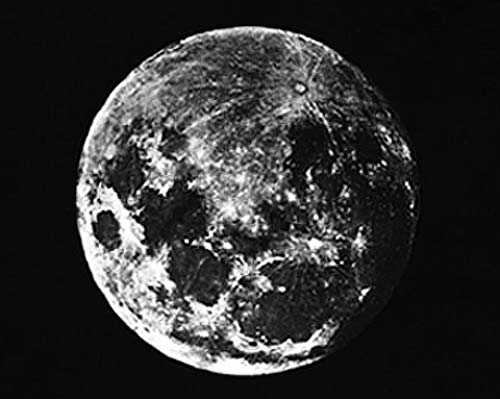
From this: Probably the first photograph of the moon, 1839
In 2013, the Hubble Space Telescope took a picture of the farthest galaxy ever discovered, the dwarf galaxy z8_GND_5296. Since far=old (that’s 13.1 billion years old), it also holds the record for the oldest object ever photographed using visible light.
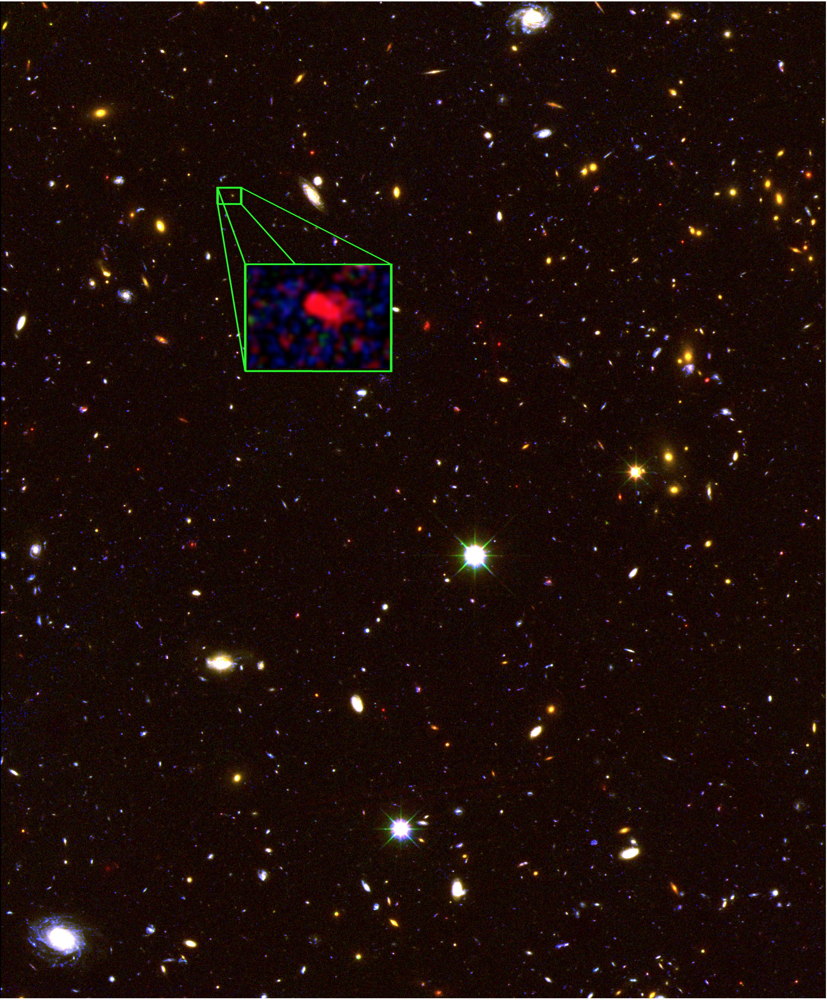
To this: A photo of the farthest galaxy ever discovered, 2013.
US Defense Secretary Chuck Hagel announced today the new Pentagon proposal for the future structure of the US Armed Forces. The New York Times carried an article yesterday giving an overview of the planned restructuring, which, in a nutshell, is all about downsizing. 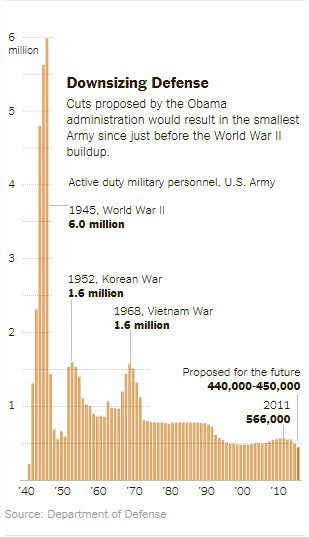 At first glance, this might look like: less troops = less fighting power. But wars, and confrontations are not, and never where, about the number of troops. They are all about the utility of force.
The paradigm of industrial war is over. That is not to say that peace has broken out. It is just that wars are no longer a force-on-force confrontation confined in space and time. War spills over into areas outside the military domain: economic and financial power, cultural domination, cognitive warfare, demographic and political power are all means by which wars are fought, but none of them involve military force, still less force numbers.
The Armed Forces are but one weapon in the US arsenal. I don’t see any decrease in the size of the other weapons.
Such as these: 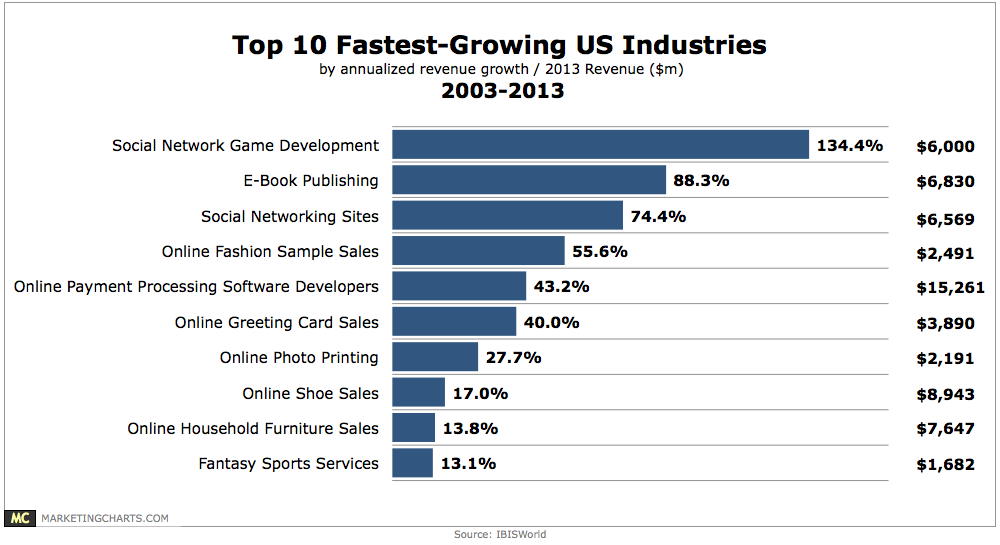
© 2026 Ivan Debono
Theme by Anders Norén — Up ↑